The Sign Said Everything
Al Green’s protest was understandable. It was also an accidental confession.

I’m a Black conservative, which means I’ve spent a lot of time watching both parties from an angle most people don’t occupy. What I saw Tuesday night at the State of the Union wasn’t just one congressman making a scene. It was a symbol — and not the one Al Green intended.
Let me be honest about something first. Calling out racism is not optional. It is not performative. It is necessary. The video Donald Trump posted during Black History Month — depicting Barack and Michelle Obama as apes — was racist. I’ve seen the full video. The “it was longer, you’re missing context” defense doesn’t hold. The entire thing was produced and shared in bad faith and in bad taste. The ape imagery was deliberate. The timing was deliberate. Trump was wrong for it, and saying so clearly is not a political statement — it’s a moral one.
So yes, Al Green had every reason to be angry. What he did next is where the story gets complicated.
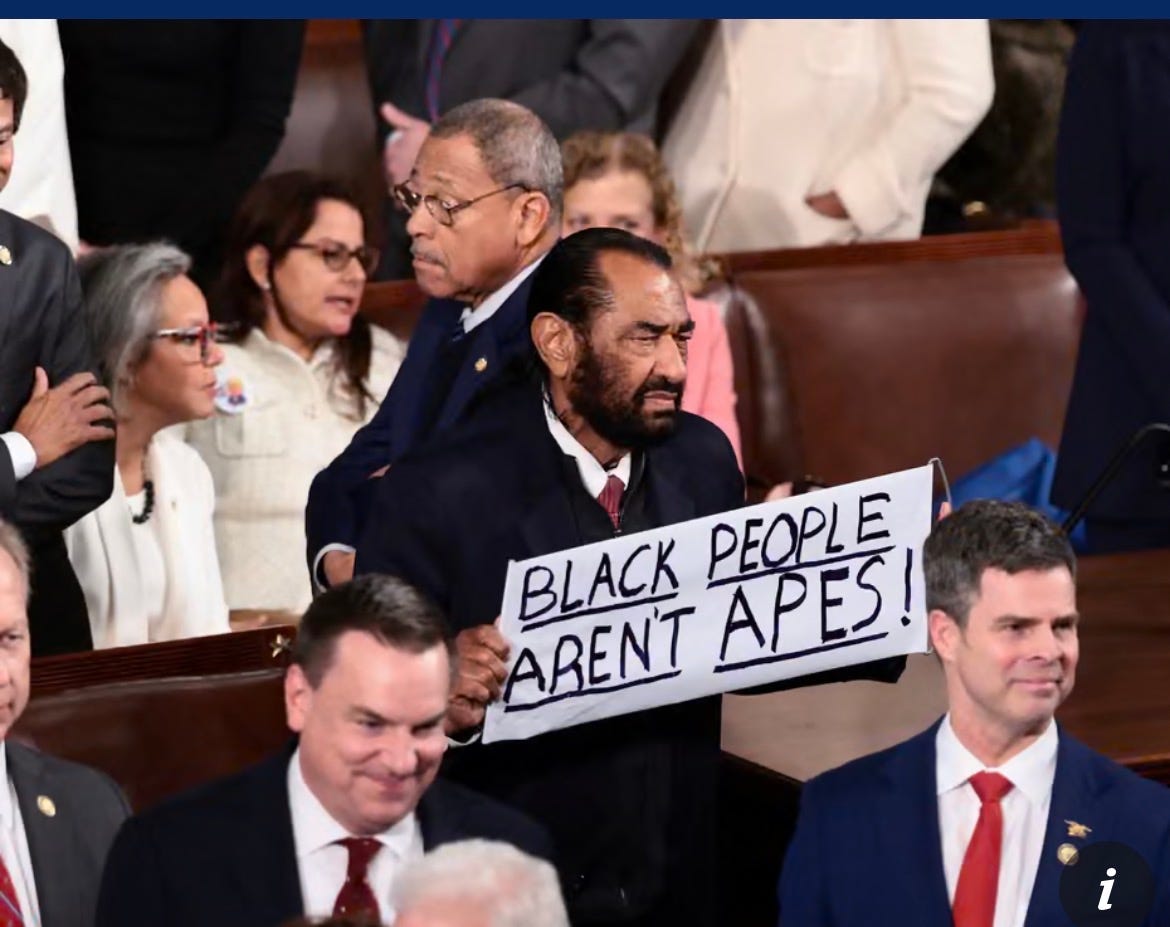
Green walked into the State of the Union with a sign. He held it up, was escorted out by security, and Republicans spent the rest of the evening passing his cardboard placard around like a trophy. Green later said this was intentional. Planned. Deliberate.
I believe him.
I just think he told on himself — and his party — without realizing it.
Here is the question nobody is asking loudly enough: if a senior United States congressman, a man who has served in the House since 2005, felt that his most powerful available response to presidential racism was a handwritten sign — what does that say about the institution he belongs to? What does that say about the party he has loyally served for two decades?
A sign is what you grab when leverage is thin.
And that’s the distinction that matters.
To be fair, Democrats remain competitive nationally. They’ve won special elections. They may well retake seats in the midterms. But winning seats is arithmetic. Building durable power is architecture. The issue isn’t whether Democrats can win elections. It’s whether they can convert outrage into leverage — whether they are constructing the kind of institutional strength that makes cardboard unnecessary.
The Democratic Party did not become institutionally strained overnight, and it would be historically dishonest to pin all of this on Donald Trump. The cracks were visible long before he entered politics — the steady erosion of state legislatures, the loss of working-class voters across racial lines, the decline in durable local party infrastructure. These are long-term structural problems.
Trump accelerated everything. He forced the Democratic Party into a reactive posture the moment he came down that escalator. A party that operates primarily in reaction eventually loses its ability to set tempo. It stops shaping the agenda and starts responding to it. When a party loses narrative leverage, even electoral wins begin to feel defensive rather than directional.
That is the deeper concern.
Trump did not create Democratic weakness. He revealed it. He turned up the heat fast enough that what had once been a slow institutional drift became impossible to ignore. Al Green’s sign is simply the most literal manifestation of a party that too often substitutes symbolism for strategy — that leans on emotional energy without consistently building the machinery that turns that energy into outcomes.
This is what made Tuesday night painful to watch — and I mean painful in the truest sense. Green is not a villain here. He is a 78-year-old man who has fought for his constituents and his community for decades. When faced with something that genuinely deserved a moral response, the sharpest weapon in his arsenal was cardboard.
That is not entirely his fault. It is the consequence of a party apparatus that has grown comfortable with viral moments, that has treated moral clarity as a substitute for power-building, that has assumed loyalty alone would sustain influence.
Protest is not meaningless. History proves otherwise. But protest works when it is connected to strategy — when it is tethered to organization, legislative follow-through, institutional pressure. John Lewis didn’t just march across the Edmund Pettus Bridge. He marched as part of a coordinated campaign with legal strategy, policy demands, and national infrastructure behind it.
What is Al Green’s sign connected to?
What coordinated legislative muscle did it activate?
What sustained pressure does it apply that did not already exist?
Those are not rhetorical questions. They are strategic ones.
The State of the Union is one of the most watched political moments of the year. The opposition party had an opportunity to demonstrate cohesion, discipline, and a forward-facing governing vision. Instead, the most enduring image from their side of the chamber was spectacle followed by removal.
That image will linger.
Al Green’s sign said Black people are not apes. He was right.
But the sign unintentionally communicated something else about modern Democratic politics: not that they cannot win elections — but that too often, they struggle to convert moral outrage into governing leverage.
Majorities come and go. Votes rise and fall.
Power is measured in what you can actually compel.
And Tuesday night, the only thing compelled was an escort out the door.
Photo credit: AP
Crying racism at every insult is also a symptomatic of a party that makes everything a moral outrage …yes the ad was in poor taste but doesn’t make it racist and Trump is not Hitler his supporters are not bootjacking fascists …earth warming is not Climate disaster ….hyperbole exposes the fact you have no argument
“…the most enduring image from their side of the chamber was spectacle followed by removal.”
I disagree. The most enduring image was a toss-up between 1) Omar and Tlaib screaming at the President and wearing profane buttons, or 2) Democrats sitting on their butts when asked if the primary mission of American government is the protection of American citizens vs. illegal aliens.
BTW, I lived in Houston for 30 years, and Al Green has accomplished almost nothing for his constituents. The last competent black congressional representative from the Houston area was Barbara Jordan.